
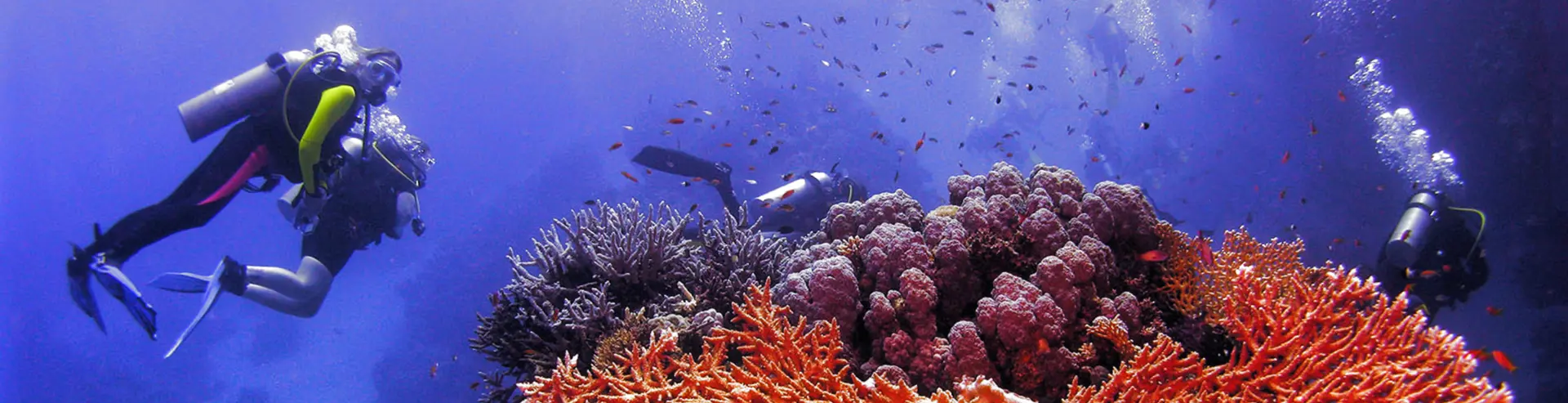
From House Reefs to World-Famous Sites
Every dive tells a different story — discover your next favorite spot beneath the Red Sea surface.
Sharm el-Sheikh is home to some of the most iconic dive sites in the world, offering crystal-clear waters, vibrant coral gardens, and unforgettable encounters with marine life. Whether you're gliding along colorful reefs, drifting past dramatic drop-offs, or exploring calm bays perfect for training, every site offers its own magic.
At Sunshine Divers Mary&Klaus, we tailor each trip to your experience level and interests — so whether it's your first dive or your fiftieth, you'll see the Red Sea at its best.
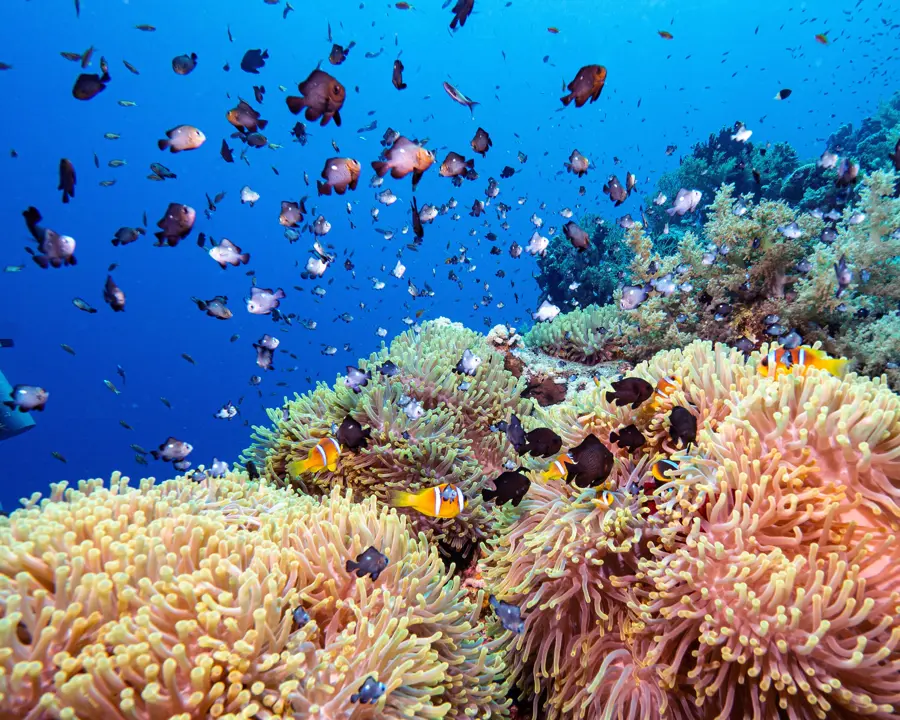
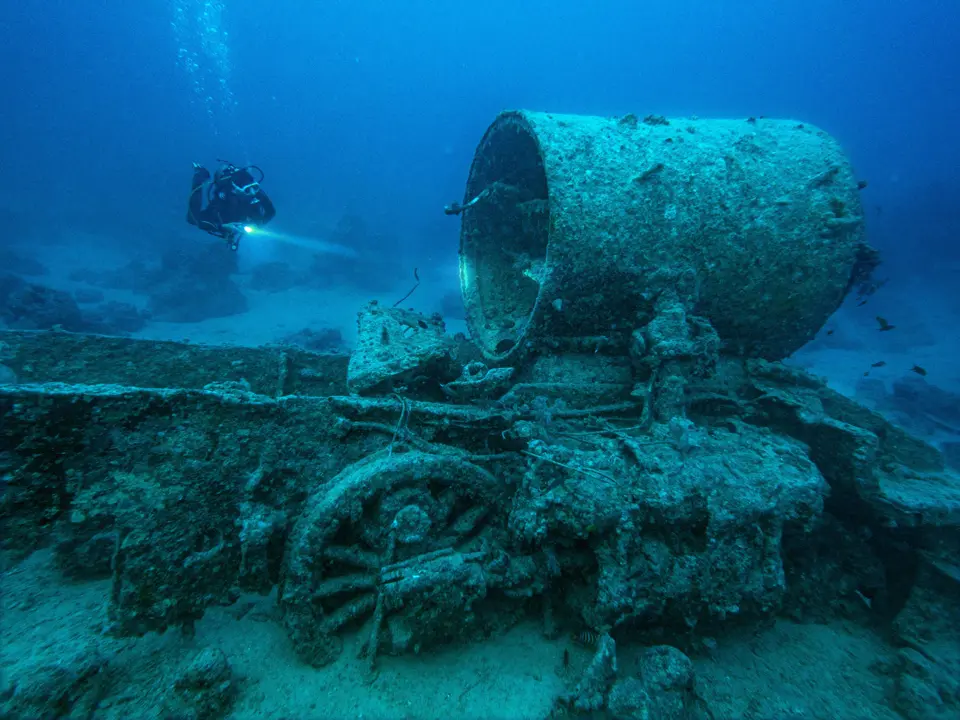
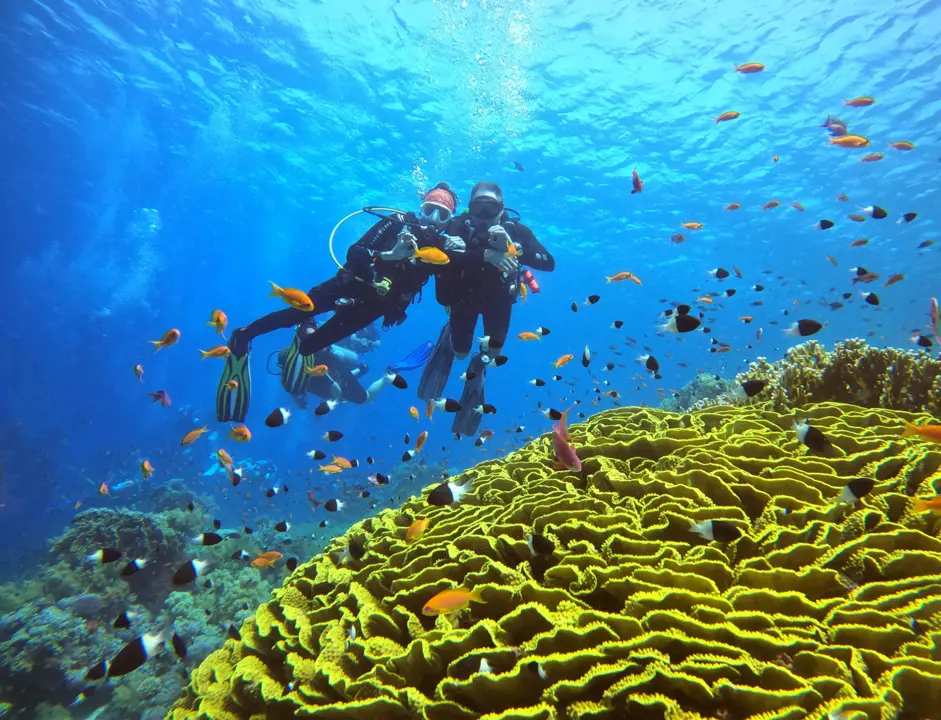
Our Favourite Dive Spots in Sharm el-Sheikh
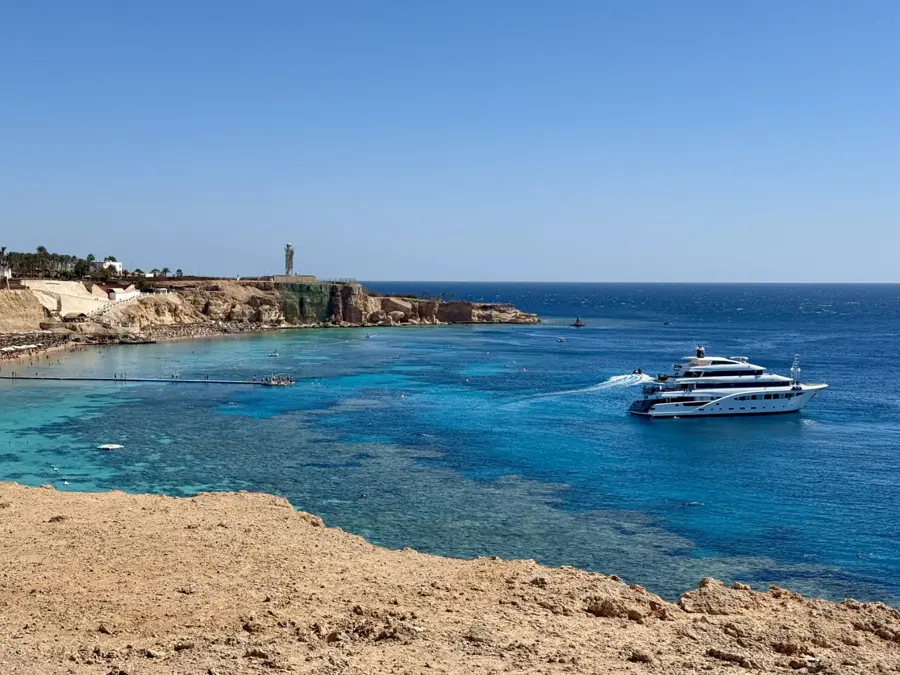
The Local Dive Sites around Sharm el Sheikh
It is no coincidence that Sharm el Sheikh is one of the most popular dive destinations in the world. Right on the doorstep of the city lies an impressive variety of dive sites - from gentle coral landscapes and vibrant reefs to spectacular walls and fascinating reef structures. And don´t underestimate these sites, we had very often encounters of the big guys there.
The local dive sites around Sharm el Sheikh have something for everyone - whether you are just taking your first breaths underwater or are an experienced diver with hundreds of dives in your logbook.
Crystal--clear water, pleasant year-round water temperatures, and an extraordinary diversity of marine life make every dive an experience to remember. Turtles, Napoleon wrasse, rays, moray eels, colourful reef fish, and the occasional shark - the underwater world here is simply spectacular.
We at Sunshine Divers Mary&Klaus know these sites inside out - and we´ll take you exactly where the magic is happening.
And here on the following pages you will find all of them explained:
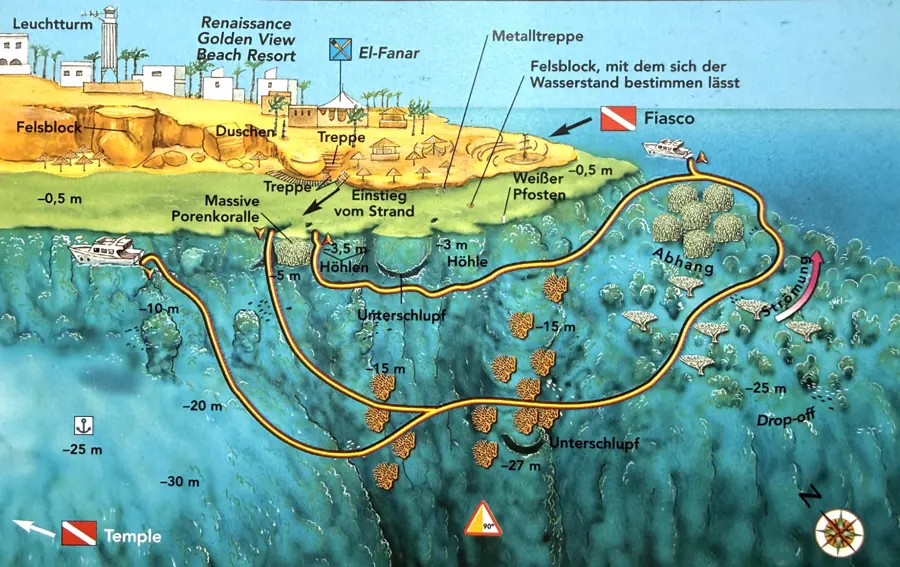
Ras umm Sid – Our House Reef, a Forest of Gorgonians and So Much More
Ras um Sid takes its name from the cape on which a large lighthouse stands, marking the western entrance to the Strait of Tiran. Directly to the east lies one of the most celebrated dive sites in the area — and our very own house reef.
What made Ras um Sid famous is its gorgonian forest: a breathtaking concentration of fan corals growing here in a density found nowhere else in the northern Red Sea. Once you've drifted through it, you'll understand immediately why this site belongs on every diver's list.
The dive begins at a large block of massive Porites coral, surrounded by swirling clouds of harem anthias. You descend to 20–25 metres, glide through the legendary gorgonian forest, then ascend to a sandy plateau at 14 metres — framed by soft coral-covered formations and filled with reef fish in every direction: lionfish, parrotfish and Napoleon wrasse are all regular company.
Divers entering from shore make their return at 5–6 metres, reef on the right, exploring crevices and small caves along the way — many of them home to glowing colonies of yellow sweepers. Those diving from the boat can continue along the wide plateau towards Paradise and be picked up at the end.
And the best part: Ras um Sid is the perfect spot for check dives, courses and night dives — accessible, sheltered and yet rich enough in marine life to reward even the most experienced diver on every visit. We also run this site as a boat dive, where it goes by the name "Local South".
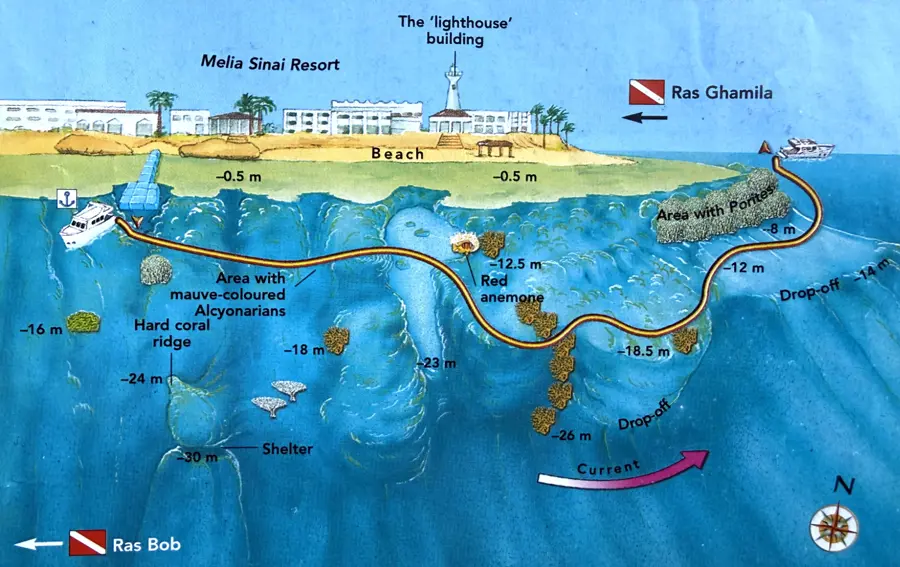
Ras Nasrani - Cape of Giants
Ras Nasrani translates from Arabic as " Cap of the Christian" and sits roughly 10 kilometres north of Naama Bay, just south of Ras Ghamila. It´s one of the few sites around Sharm el Sheikh that can actually be reached by land - via the access road to the Baron Resort or Melton Beach Resort. That said, the classic dives is done from the boat as a relaxed drift, letting the current carry you through one of the most species-rich-stretches of reef in the area.
We go with our boat weekly to this divesite, when the schedule says: Local North.
The dive begins at a floating jetty, next to a large coral block perched above a cave that opens at 30 meters depth. From here you ascend towards a sandy bay, where a stunning red anemone awaits on the northern side at 12 meters - one of those small details that stays with you.
From this point, corals take over completely. You head northwards with the reef on your left, carried along by a gentle to moderate current that builds as you approach the cape. Large gorgonians at 20 meters give way to vast, impressive colonies of massive Porites corals forming huge banks - growing even denser beyond the headland. At the tip of the cape the current can become quite strong, and rays are sometimes spotted here, hovering in the flow as they hunt for food.
The route continues along the reef slope, threading through colourful soft coral-lined crevices down to a dramatic drop-off at 30 meters.
And the best part: Ras Nasrani is the place in the entire Red Sea to encounter giant clams. No other location in the Red Sea hosts a higher density of theses remarkable bivalves than here. Their mantles glow in vivid blues and greens thanks to symbiotic zooxanthellae - and many are so tightly embedded within the Porites coral that they look like jewels set into the reef itself.
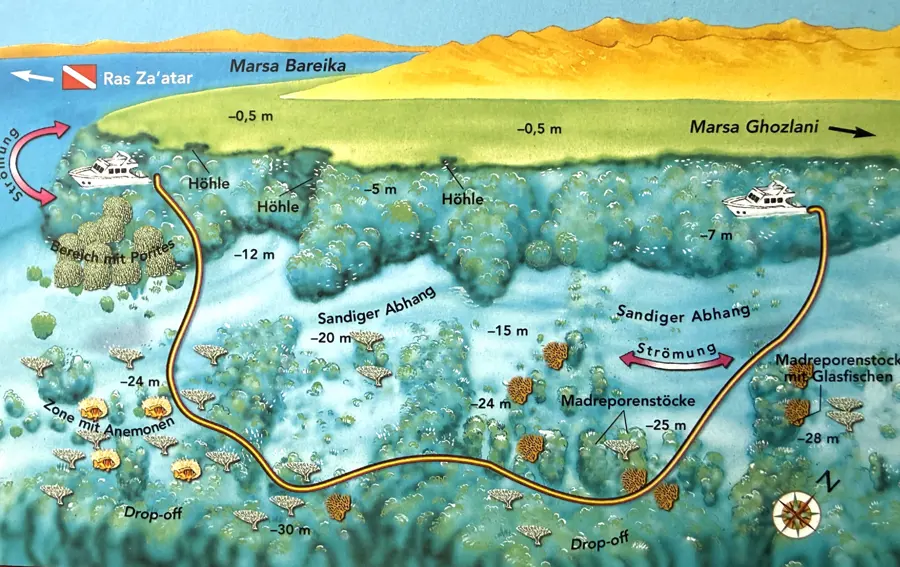
Ras Ghozlany – Coral Forest at the Gates of Bareika Bay
The deep bay of Marsa Bareika is bookended by two dive sites: Ras Ghozlany at its northern tip and Ras Za'atar to the south. Both are accessible by boat and, with the right current, offer beautiful drift dives — with Ras Ghozlany providing the more dramatic opening act.
The dive unfolds along a wide, sun-drenched slope that begins at 6 metres and descends gradually to the drop-off at 25–30 metres. Along the way, coral towers rise from the reef, draped in red and pink soft corals and wrapped in dense, swirling clouds of anthias — a combination of colour and movement that sets the tone for the entire dive.
Towards the drop-off, the scenery takes on an almost otherworldly quality. Large table corals and branching formations grow from the sandy floor like trees in a forest — particularly at the bay entrance, where the effect becomes a genuine coral forest that draws the eye in every direction. Batfish, yellow sweepers and basslets shelter beneath the table corals, while on the sandy floor below, bluespotted rays, pufferfish and triggerfish go about their business undisturbed.
And the best part: with the right current, Ras Ghozlany lends itself perfectly to a drift dive along the northern headland — let the current do the work and simply take in the coral scenery around you.
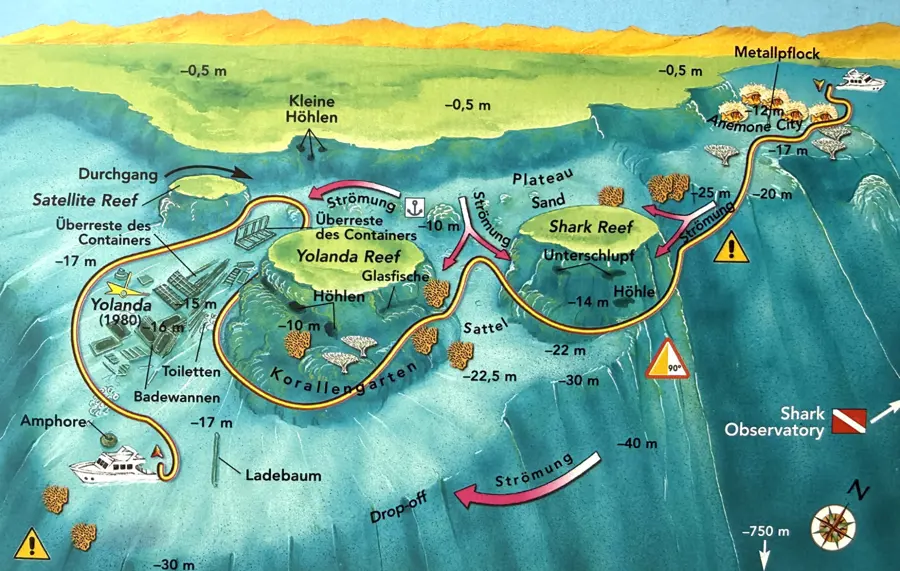
Shark & Yolanda Reef – Sharm el Sheikh's Most Legendary Dive
Some dive sites have a good reputation. Shark & Yolanda Reef has a legend — and it's well earned. Widely regarded as the most spectacular dive site around Sharm el Sheikh, it still features in several world dive guides among the very best on the planet. Drop below the surface here and you'll understand immediately why.
The underwater landscape is extraordinarily varied, and the sheer abundance of reef and pelagic life has a way of leaving even seasoned divers lost for words. Massive schools of barracuda, dense formations of jackfish, battalions of batfish — it unfolds like something out of a nature documentary, and it never gets old. The summer months are when the site truly comes into its own, when conditions align and the reef shows its full hand.
That said, Shark & Yolanda is not a dive for everyone. Currents here can be seriously powerful, and experiencing this place at its best requires experience, solid buoyancy control, and the ability to read the water. We plan every dive here carefully — route, direction and depth are adapted to the conditions on the day.
And the best part: the surrounding reefs are close enough that Anemone City and Yolanda Reef can easily be combined into a single dive. Anemone City lives up to its name entirely — entire colonies of sea anemones and their resident clownfish carpet the reef between 12 and 20 metres, spread across a wide rocky shelf that juts out into the blue like a vast natural balcony. Colourful, alive, and completely captivating.
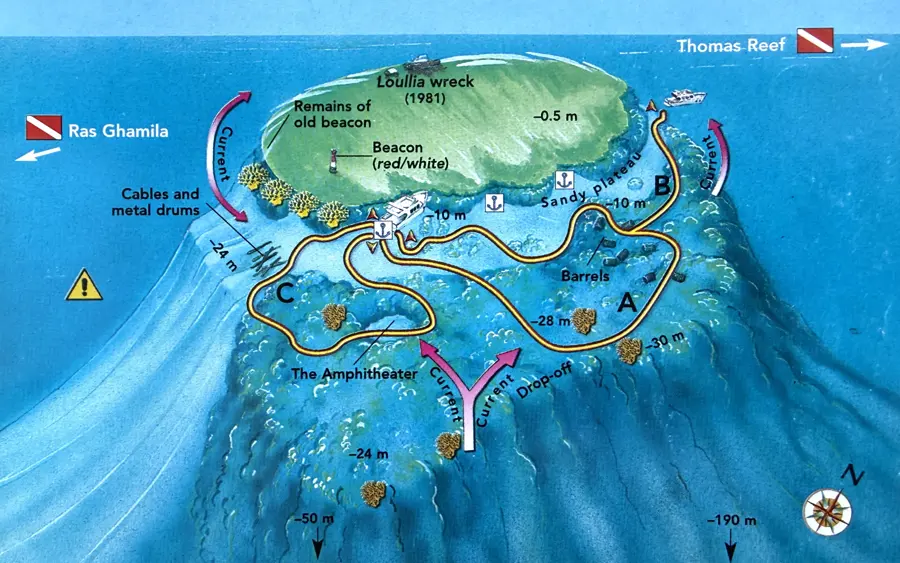
Gordon Reef – Wreck, Amphitheatre and Perfect for All Levels
Gordon Reef is hard to miss — the rusting hull of the Loullia, a Panamanian cargo ship that ran aground on the northern tip in September 1981, is visible from the surface and has long since become a landmark in its own right.
Compared to the other Tiran reefs, Gordon is the most approachable. A fixed mooring on the southern side and a wide, relatively shallow plateau (10–24 metres) spreading out to the south-west make this a more relaxed dive than its neighbours. A red and white beacon marks the south-western corner. From the mooring, you have several options:
Route 1
heads east from the mooring point, then northwards along the eastern wall. Halfway along, you'll spot a curious scatter of metal drums at 10–20 metres depth. From here you can turn back, or continue drifting north to a small sandy plateau where garden eels sway in the current.
Route 2
takes you out across the broad southern plateau. The highlight here is the "Amphitheatre" — a circular, sand-filled hollow also known locally as the "Shark Pool" — followed by a tangle of cables and metal bars. You can return to the mooring either along the reef edge or, for the more adventurous, by drifting along the western side through a zone of fire corals.
One important note: the south-western corner near the beacon can produce a surprisingly strong current. At its worst, it can make returning to your boat extremely difficult — keep an eye on it throughout your dive.
And the best part: Gordon Reef is one of the few Tiran sites that's also perfect for snorkelling! The sheltered mooring on the southern side provides a safe, wind-protected base — ideal for anyone wanting their first glimpse of Red Sea underwater life without scuba gear.
All Dive Sites around Sharm El Sheikh
It is no coincidence that Sharm el Sheikh is one of the most popular dive destinations in the world. Right on the doorstep of the city lies an impressive variety of dive sites - from gentle coral landscapes and vibrant reefs to spectacular walls and fascinating reef structures. And don´t underestimate these sites, we had very often encounters of the big guys there.
The local dive sites around Sharm el Sheikh have something for everyone - whether you are just taking your first breaths underwater or are an experienced diver with hundreds of dives in your logbook.
Crystal--clear water, pleasant year-round water temperatures, and an extraordinary diversity of marine life make every dive an experience to remember. Turtles, Napoleon wrasse, rays, moray eels, colourful reef fish, and the occasional shark - the underwater world here is simply spectacular.
We at Sunshine Divers Mary&Klaus know these sites inside out - and we´ll take you exactly where the magic is happening.
And here on the following pages you will find all of them explained:
The standard species mix on these reefs is the regional Red Sea fauna at modest depth. Hard and soft corals on the slopes and walls. Reef fish in numbers across the structure. The local sites also retain the chance of larger encounters: manta rays and whale sharks pass through, especially during the seasons when plankton concentrations bring them inshore.
Just a few hundred metres west of Temple lies Ras Katy — similar in structure to its famous neighbour, but with one clear advantage: the site is exceptionally well sheltered from prevailing winds, making it a reliable and comfortable choice even when conditions elsewhere are less cooperative.
The dive begins at a striking coral tower that rises almost to the surface, ringed with small hard corals and vivid raspberry corals. From here, a gently sloping sandy plateau descends from 5 metres down to the drop-off at 18–20 metres, where a handful of gorgonians mark the edge.
Exploring the plateau, you'll come across two further coral towers at intervals of a few dozen metres — richly covered in soft corals and surrounded by reef basslets, broccoli corals, butterflyfish, sergeant majors and fusiliers. Peer into the wall crevices and you'll find glassfish, lionfish and big-eye soldierfish tucked into the shadows. On the sandy floor in the southern section, crocodilefish and scorpionfish lie in masterful camouflage, while bluespotted rays rest quietly nearby.
And the best part: when the tide is rising, a pleasant current sometimes picks up — perfect for drifting the 400 metres along the reef all the way to Temple, effortlessly and in style.
The headline encounter is a resident white-tip reef shark. The shark lives in about 28m and circles off the reef. Sharks hear well; this one knows you are coming before you see it. If you stay in the area without chasing, the shark often doubles back to investigate. The trick is not to pursue.
The southern corner at 26m holds large groups of Red Sea bannerfish and red-tooth triggerfish over the reef. They group together in numbers and stay put, which makes them photographable.
The shallow option around the surface-rising pinnacles holds the standard local-site mix in dense numbers because of the structure complexity.
In the middle of the wide bay stretching between Ras um Sid and Ras Katy, backed by a towering fossil coral cliff, lies Temple — one of the most iconic and most-visited dive sites in the entire area.
The name dates back to the early 1970s, when the first divers here encountered three imposing coral towers rising from a sun-drenched plateau between 6 and 30 metres — soaring upwards like the columns of an ancient temple. The comparison stuck, and so did the name.
Temple's popularity comes as much from its accessibility as its beauty: the dive is technically straightforward, reliably diveable regardless of weather, and easy for boats to moor at — making it a perfect choice for all experience levels. It has admittedly felt the effects of heavy footfall over the decades, but look carefully and the site still delivers. Butterflyfish in impressive variety, parrotfish, lionfish, dense schools of batfish and the occasional stately Napoleon wrasse all call Temple home.
And the best part: before making your way back to the towers, take a brief detour to the drop-off at 30 metres. A beautiful, solitary gorgonian waits there — overlooked by most divers who never quite make it that far. Find it, and you'll feel like you've seen the real Temple.
The deeper pinnacle (top 12m, bottom 18m) holds the dive's species concentration. Soft corals on the upper section. Pipefish in the structure. Glassfish in dense schools across the top. The current usually hits the left side of this pinnacle, which keeps the soft corals at their best.
The first pinnacle has a feisty clownfish that defends its small territory aggressively against approaching divers. The territorial display is photographable if you settle and let it play out.
Ras um Sid takes its name from the cape on which a large lighthouse stands, marking the western entrance to the Strait of Tiran. Directly to the east lies one of the most celebrated dive sites in the area — and our very own house reef.
What made Ras um Sid famous is its gorgonian forest: a breathtaking concentration of fan corals growing here in a density found nowhere else in the northern Red Sea. Once you've drifted through it, you'll understand immediately why this site belongs on every diver's list.
The dive begins at a large block of massive Porites coral, surrounded by swirling clouds of harem anthias. You descend to 20–25 metres, glide through the legendary gorgonian forest, then ascend to a sandy plateau at 14 metres — framed by soft coral-covered formations and filled with reef fish in every direction: lionfish, parrotfish and Napoleon wrasse are all regular company.
Divers entering from shore make their return at 5–6 metres, reef on the right, exploring crevices and small caves along the way — many of them home to glowing colonies of yellow sweepers. Those diving from the boat can continue along the wide plateau towards Paradise and be picked up at the end.
And the best part: Ras um Sid is the perfect spot for check dives, courses and night dives — accessible, sheltered and yet rich enough in marine life to reward even the most experienced diver on every visit. We also run this site as a boat dive, where it goes by the name "Local South".
The right-turn shallower route concentrates hard corals and porite coral structures. The fauna sitting on these structures follows the standard local-site mix.
The left-turn deeper route opens into the fan coral forest at depth. Each fan is a small ecosystem. Slow approach.
The plateau past the wall holds soft corals and the dive's most varied species mix, with eagle rays passing through the blue beyond. Summer plankton conditions bring mantas and the occasional whale shark to the open water above the plateau.
The name is no exaggeration. What sets Paradise apart from the neighbouring sites along this stretch of coastline — including Amphoras and Turtle Bay — is not its basic structure, which shares the familiar profile of reef slope and drop-off. It's what has grown on the plateau in between: coral formations that look less like reef and more like sculpture.
Red, pink, yellow — the soft corals here paint the plateau in a density and variety that is genuinely unique. Table corals and gorgonians complete the picture on the sea floor, creating a landscape that feels unlike anywhere else in the area.
The classic dive departs from the boat and, in suitable conditions, follows a drift southwards with the reef on the right. At the drop-off, between 24 and 28 metres, you turn the reef to your left and glide between the coral sculptures — slowly, because this is not a place to rush.
And the best part: the marine life matches the corals for variety. Parrotfish and stately Napoleon wrasse cruise the reef, butterlyfish and harem anthias fill the water in cheerful abundance, and in the southern section, giant moray eels tuck themselves into the crevices of coral blocks — easy to miss if you're not looking, impossible to forget once you've found one.
The 16m pinnacle a few metres from the jetty is the dive's species concentrator and the first place to commit serious bottom time, because most of what makes Paradise distinct as a site happens on this single piece of structure rather than across the broader reef profile. Frogfish have been recorded here historically — sightings are not guaranteed but the pinnacle is the place to look. A large fan coral with glassfish swarming around it sits on the same structure, and a yellow-mouthed moray lives close by.
The 18–22m section between pinnacles holds the standard local mix. Scorpionfish and nudibranchs colonise the reef wall and reveal themselves on the shallower return leg. Summer afternoons add the chance of mantas passing through the open water beyond the wall.
The name carries centuries within it. Amphoras takes its title from a Turkish merchant vessel that sank here in the 17th century, carrying a cargo of amphorae filled with mercury. The ship itself has long since disappeared — but the traces it left behind are still there, waiting quietly on the sandy bottom.
The site lies south-west of Tower and the dive begins at a simple, wave-washed concrete jetty, a few dozen metres south of the more prominent floating pier. From here you descend onto a sun-drenched slope that begins at around 10 metres, richly decorated with coral formations and colourful soft corals that together form a genuinely impressive coral garden — the kind of place you could happily spend an entire dive without going any deeper.
At 22 metres, a long heavy chain leads southwards to a modern anchor tucked behind a coral block at 25 metres. Heading north with the reef on your left, you pass a series of coral towers — one of them surrounded by a swirling cloud of harem anthias and sheltering dense colonies of yellow sweepers in its crevices. Further along, a large table coral rises in front of two imposing coral towers, forming a natural gateway to the highlight of the dive.
And the best part: just behind them, at around 24 metres depth, lies the original anchor stock of the sunken vessel, its inscriptions still partially legible, alongside scattered remains of the amphorae that once formed its cargo — silent witnesses to a journey that ended more than three centuries ago.
The pinnacles between the wall and the drop-off hold the standard local-site mix. Glassfish in schools. Feather stars on exposed surfaces. Starfish in the cracks. None of this fauna belongs only to Amphoras, but the structure is dense enough to reward a slow dive even if every species you see exists at the neighbouring sites as well.
The historical artefacts are the dive's distinctive feature, not the marine life. Treat the amphoras and anchor stick as the priority and the species mix as supporting context.
The name gives it away immediately: Pinky Wall takes its title from the extraordinary density of pink soft corals that drape the entire reef face — a sight unlike anything else along this stretch of coastline.
And it's not just the colour that sets it apart. The reef structure here is fundamentally different from neighbouring sites: there is virtually no shallow plateau to speak of. Instead, the wall drops away almost immediately, plunging to depths of over 180 metres in a near-vertical, dizzying descent.
The dive follows the wall with the reef on your left, at an average depth of around 15 metres — the sweet spot where soft coral coverage is at its most spectacular and colours are at their most vivid. Continuing north-eastwards, a series of majestic gullies interrupts the vertical face, overlapping one another in a formation that local divers have long compared to organ pipes — a striking piece of natural architecture rising from the reef wall.
Throughout the dive, a colourful cast of parrotfish and wrasse move along the wall, joined by various species of grouper lurking in the coral crevices.
Tower is one of the most dramatic dive sites around Sharm el-Sheikh — and the reason is right beneath you: a deep canyon whose walls plunge vertically to over 120 metres. The water here is crystal clear, making the sheer scale of the drop feel even more breathtaking.
The dive starts from the bay, at the level of a striking fossilised coral block — the "tower" that gives the site its name. Keeping the reef to your left, you descend to 15 metres and soon reach the edge of a gently sloping sandy plateau stretching between 12 and 25 metres depth, dotted with scattered coral formations. Standing at that edge, looking out into the canyon, is one of those moments that stays with you.
The return follows the same route, but shallower — between 12 and 15 metres — where the reef's crevices reward careful exploration. Tucked inside, a small cave shelters a colony of vivid yellow sweepers, one of those small, glowing discoveries that make a dive memorable.
And the best part: before surfacing, don't miss the two large caves at the canyon entrance towards the beach, sitting at around 5 metres depth. Dense clouds of glassfish fill the openings, with lionfish and big-eye soldierfish lurking in the shadows behind them — a perfect finale to a truly spectacular dive.
The 18m canyon wall is the dive's busiest section. Glassfish fill the overhangs in dense clouds. Cave sweepers occupy the darker pockets. Light penetrates deep through the clear water beyond the wall and creates sun beams that appear to rise from the canyon's invisible bottom — the visual is the canyon's signature.
Past the canyon, the slope and ridge pinnacles support nudibranch and small starfish populations. Slow approach. The end-of-dive overhang shelters red fire sponges with pyjama nudibranches. The safety stop happens on top of the final pinnacle, which is covered in blue stag coral, with sergeant majors schooling around the diver.
Sodfa doesn't need to announce itself — it simply delivers. From the boat, you drop into a drift dive along a sun-drenched slope, the reef edge always within sight and the blue of the drop-off at 18–25 metres drawing you gently deeper.
The profile is forgiving enough for newer divers, while the drop-off and deeper structures give experienced divers room to explore. Coral towers rise from the sandy slope at around 12 metres, while table corals and fan corals line the ridge edge above the drop-off. At 20–22 metres, gorgonians frame the drop-off in quiet elegance.
And the best part: the marine life keeps things lively throughout. Fusiliers, surgeonfish, triggerfish, anthias, parrotfish and the occasional lionfish move through the reef, set against a backdrop of massive Porites formations and sweeping table corals that give Sodfa its characteristic warmth and colour.
Table corals and fan corals dominate the ridge edge. They are the structural shelter for the resident reef fauna, which follows the standard local-site mix — small reef fish, schooling juveniles, occasional larger predators on a slow pass.
The site does not have a single named species attractor the way the Gardens do. Treat it as a reliable local reef rather than a target dive.
Near Garden is the closest of the four Garden sites to Naama Bay — and often the first dive site guests experience. The reef wall drops to 8–10 metres and slopes gently to a drop-off at 18–20 metres, with coral pinnacles scattered along the route giving the site its distinctive three-dimensional character.
Two features anchor the dive, and the topography places them perfectly — both at depth, both close to the wall, encountered one after the other without any need to choose or detour. First comes a magnificent red anemone, vivid against the reef. Just ahead of it, a glassfish pinnacle so densely populated that a photographer could spend an entire dive there without running short of subjects.
And the best part: Near Garden is accessible and well-structured, yet never dull. It's the ideal introduction to the Gardens of Naama Bay — and a site that rewards return visits just as generously as the first.
The glassfish pinnacle is the species concentrator. Nudibranch crawl across the structure. Shrimps occupy the cracks. Blennies look out from holes. Christmas tree worms decorate the surface. Banded pipefish hover near the base. Each species is a separate macro subject, and the pinnacle could swallow a 60-minute dive entirely.
The red anemone just before the pinnacle is the establishing visual. The flat bottom past the corner holds large fan corals at 22m. The corner itself, where current is strongest, has the healthiest and most colourful soft corals on the dive.
Manta rays are a summer-month possibility. Watch the open water beyond the corner, especially during plankton-rich afternoons when the productive feeding conditions that bring mantas inshore on the local stretch tend to peak in this part of the bay.
The name says it all. Middle Garden sits at the centre of the Gardens bay, between Far Garden and Near Garden, roughly level with the sprawling Hyatt Regency complex. And it genuinely lives up to its name — this place really does feel like a carefully tended underwater garden.
The dive opens on a broad sandy plateau that slopes gently down to the reef edge at 5–6 metres, with the drop-off lying between 12 and 14 metres. After a few dozen metres, the plateau narrows and transforms into a beautiful white sand avenue, lined with corals and punctuated by massive Porites coral formations rising from the sea floor like small towers.
It's these coral structures — scattered in every direction, separated by narrow sandy pathways that genuinely resemble garden lanes — that gave this site its name. Middle Garden is a place to wander and explore, not to rush.
Experienced divers with enough air can push further to the pinnacles of Fiddle Garden. Alternatively, an outgoing tide opens up a lovely drift dive south-westwards towards Near Garden — well worth it when conditions allow.
And the best part: the marine life here is as varied as it is reliable. Fusilier shoals, pufferfish, triggerfish, sergeant majors and damsels fill the water column, while bluespotted rays and spotted eagle rays glide quietly across the sandy floor below — regular visitors that never lose their appeal.
The opening sandy patch is the macro section. Rays on the sand. The blue-spotted shield slug working the substrate. Slow approach. Sand stir kills both sightings.
On top of the hard coral mountains that flank the sand road, groups of goatfish hold position. Trumpet fish hover above the structure. Schools of big-eyed emperors pass over the mountain tops in formation.
The northeast corner of the dive ends at a glassfish pinnacle. The rare ornate ghost pipefish has been recorded here. The species is small, well camouflaged, and easy to miss; if it is the priority of the dive, slow down considerably at this pinnacle.
Tucked between Middle Garden and Far Garden in the bay just north of Naama Bay, Fiddle Garden is a site with a clear structure and one moment that divers remember long after the surface interval.
The dive follows a satisfying three-act layout: an opening wall at 6–8 metres, a sandy slope leading to the drop-off at 18 metres, and a row of three pinnacles marking the natural turnaround point. Easy to navigate, easy to read — and yet the real magic happens in between.
Between 10 and 16 metres, a single coral pinnacle draws all the attention. It's thick with glassfish — and even more reliably, with cleaner wrasse running a full-service cleaning station. Remove your regulator, open wide, and they'll get to work without hesitation. This particular pinnacle once featured on a British children's wildlife programme, where the challenge was simple: let the cleaner wrasse clean your teeth underwater.
And the best part: nothing has changed. The pinnacle is still reliably populated, the cleaner wrasse are still on duty, and the moment is there for the taking on every single dive — if you're willing to commit to it.
The glassfish pinnacle holds the densest single concentration on the dive. Cleaner wrasse work the cleaning station actively. The three pinnacles at the turn each have their own glassfish populations, and the last one in particular is swarmed.
Look inside the glassfish schools. Baby barracuda hide there, lionfish hang nearby waiting for the schools to scatter, and the predator-prey dynamic plays out in slow motion across the dive's middle section. On the return, watch for stonefish in the rubble between pinnacles.
Just north of Naama Bay, four dive sites line up along a spectacular stretch of reef known collectively as "The Gardens": Near Garden, Middle Garden, Fiddle, and at the far end — Far Garden. Its distance from the bay entrance earns it slightly cleaner water, less disturbance, and a corner plateau where pelagic encounters are a regular highlight.
Two enormous coral pinnacles rising almost to the surface mark the entry point with no need for GPS or marker buoys — even on the haziest morning of the season, the boat skipper will spot them without hesitation. Descend slowly. Take your time. Those who actually pause at the pinnacles rather than swimming straight past will be rewarded: blennies peer out from their holes, tiny personalities hiding in plain sight.
Beyond the pinnacles, Far Garden reveals its real character — a plateau nestled between the reef plate and the drop-off, its slope gradually steepening towards the east. Smaller coral towers are scattered across this middle ground, creating a layered, three-dimensional landscape that rewards curious divers who like to explore rather than simply follow a line.
And the best part: Far Garden works equally well as a circular dive or a drift dive, depending on conditions and mood. Either way, it delivers.
The floor between pinnacles has an unusual feature for this stretch of coast: upside-down jellyfish that look like rice pudding with almonds sprinkled on top. They are easy to dismiss as detritus until you look closely. The two opening pinnacles host blennies and the standard small reef fauna.
Toward the corner plateau at the dive's far end, the visual scale changes. Summer brings whale sharks, mantas, and the occasional hammerhead through the area. Octopus on the reef change colour and texture in real time when divers approach. Napoleon wrasse are residents and visible on most dives.
White Knight is a small, richly reef-fringed bay with a distinctive indentation that spreads across a sandy plateau between 6 and 18 metres depth. The fixed mooring sits close to a colony of Red Sea garden eels — a calm, sheltered starting point for a dive full of discoveries.
In the south-western section of the bay, a beautiful canyon opens up from 8 metres, its sandy floor dropping all the way down to 38 metres. The eastern canyon wall is formed by two large coral blocks, home to an impressive table coral and a lettuce coral. To the side of the canyon entrance, a narrow passage begins at 10 metres and joins the main canyon at 13 metres — easy to miss, and all the more satisfying when you find it.
Deeper into the canyon, the discoveries keep coming. At 19 metres, an old metal barrel marks the entrance to a first cave. A second cave opens on the opposite side at 21 metres. And the best part: at 27 metres, a small "balcony" sits on an overhang — complete with a genuine sand waterfall, trickling silently into the depths below. To the left of the balcony, a third cave entrance leads into a surprisingly steep ascent.
From the balcony, you have two options: head north and return to the starting point, or continue south-westwards to where the dive boat Noose One once rested — a vessel that caught fire and sank in 1996, then slid further down the slope in 2004. Today only scattered metal parts, air tanks and engine components remain, but for those who know the story, it adds one more layer to an already fascinating dive.
You won´t find "Ras Bob" on any nautical chart - even many locals draw a blank at the name. It was coined by a group of Sharm el Sheikh dive instructors in honour ob Bob Johnson, a well-known underwater cameraman who spent many years working in this area. Officially, Ras Bob is simply the southern section of Ras Nasrani - unofficially, it is one of the most relaxed and welcoming dive sites along this stretch of coast.
Sheltered form waves and wind, with typically gentle currents, Ras Bob is the perfect choice when you are after a calm, unhurried dive. The boat moors at a bouy in 20 meters of water. From there, you follow the reff slope north-eastwards at 15-20 meters depth until you reach the turnaround point, then wind your way back along the narrow reef crest.
Along the reef edge you will find a series of small sandy bays, their bright sandy floors dotted with crevices and small caves at 3-6 meters depth. Look carefully and you will spot bluespotted stingrays resting lazily on the sand and crocodilefish lying perfectly camouflaged, waiting patiently for their next meal. The most interesting section lies between 4 and 12 meters - making this an excellent choice for less experienced divers too.
And the best part: snorkelers are just as well catered for. The reef to the east and west of the mooring is rich in both hard and soft corals, and easy to explore at the surface - no scuba gear required.
The shallow zone is the dive's productive section. Octopus are seen here regularly, working their way through the structure and changing colour as they move. Sergeant majors hang in groups in the shallows, defending small patches of substrate aggressively.
The eel garden at 22m is the deeper subject. The eels emerge from the sand in a colony, sway in the current to feed, and retreat at the slightest disturbance. Approach is the same as at any garden eel site: settle on the bottom downcurrent and wait.
Ras Nasrani translates from Arabic as " Cap of the Christian" and sits roughly 10 kilometres north of Naama Bay, just south of Ras Ghamila. It´s one of the few sites around Sharm el Sheikh that can actually be reached by land - via the access road to the Baron Resort or Melton Beach Resort. That said, the classic dives is done from the boat as a relaxed drift, letting the current carry you through one of the most species-rich-stretches of reef in the area.
We go with our boat weekly to this divesite, when the schedule says: Local North.
The dive begins at a floating jetty, next to a large coral block perched above a cave that opens at 30 meters depth. From here you ascend towards a sandy bay, where a stunning red anemone awaits on the northern side at 12 meters - one of those small details that stays with you.
From this point, corals take over completely. You head northwards with the reef on your left, carried along by a gentle to moderate current that builds as you approach the cape. Large gorgonians at 20 meters give way to vast, impressive colonies of massive Porites corals forming huge banks - growing even denser beyond the headland. At the tip of the cape the current can become quite strong, and rays are sometimes spotted here, hovering in the flow as they hunt for food.
The route continues along the reef slope, threading through colourful soft coral-lined crevices down to a dramatic drop-off at 30 meters.
And the best part: Ras Nasrani is the place in the entire Red Sea to encounter giant clams. No other location in the Red Sea hosts a higher density of theses remarkable bivalves than here. Their mantles glow in vivid blues and greens thanks to symbiotic zooxanthellae - and many are so tightly embedded within the Porites coral that they look like jewels set into the reef itself.
Each section has its own dominant species. The hard-coral wall section is the fusilier zone. They swarm in the blue and frame the wall throughout that part of the dive in numbers that take a few seconds to register when you first descend. The corner brings the soft-coral colour layer; look up rather than down to see the visual best.
The porites mounds at the dive's far end are where the goatfish school. Hidden between the mounds and along their bases sit scorpionfish and stonefish in numbers that the casual observer always undercounts. Both species blend into the substrate well. Slow down. Stir nothing. Approach low.
"Ras Ghamila" translates from Arabic as "Delightful Cape" — and it delivers on that promise. The name doesn't appear on any official chart, but every diver in Sharm el-Sheikh knows it: it refers to the tongue of reef that juts eastward into the sea, supporting the green beacon that marks the western entrance to the Strait of Tiran. Every vessel travelling south from the ports of Aqaba and Eilat must pass through this narrow gap — between this green beacon and the red and white one on Gordon Reef.
The reef itself separates a wide, shallow sandy lagoon from the open sea, creating a natural setting that makes for a truly special dive.
Ras Ghamila offers a lovely drift dive — interesting enough to keep experienced divers engaged, but gentle enough not to be off-putting. The classic route, which should always be followed when the tide is coming in, begins just past the last hotel buildings of Montazah. From here you drop onto a broad, gently sloping sandy plateau at around 15 metres and drift northwards in an almost effortless glide, staying parallel to the reef edge at beacon level.
And the best part: on the gentle reef slope — which rises to an average depth of around 8 metres — enormous Porites coral colonies have built up over the years. Giant triggerfish cruise past unhurriedly, while large table corals dominate the plateau below, surrounded by swirling schools of pelagic fish. It's a relaxed, visually stunning dive that captures everything that makes the Red Sea so special.
Giant gorgonian fans hold the most reliable encounters: turtles around the fans, glassfish schooling in their branches, the occasional larger predator passing through to investigate the gathering. The hard-coral floor between fans supports the standard reef fauna in less concentrated form.
In the shallow sandy patches at the inner end of the slope, feather-tailed rays settle on the sand. They are easy to miss unless you slow down through the shallows on the dive's exit. Watch for outlines in the sand rather than full ray shapes.
The Million Hope is a remarkable bulk cargo carrier measuring 174 metres in length, which ran aground on the reef north of Sharm el Sheikh in June 1996 while on a voyage from Jordan to Taiwan. All 25 crew members were rescued safely. Before the ship sank, its entire cargo of potash and phosphates was successfully removed, preventing any significant damage to the surrounding reef.
The wreck sits upright on the seabed at a depth of 21–24 metres, with a slight list to port. The cranes and parts of the superstructure still break the surface, while the main deck lies at just 4–5 metres and the port deck edge at around 6 metres. A dive along the full length of the wreck takes you from the massive propellers at the stern all the way to the impact zone at the bow.
For those who want to explore further, a breach in the hull provides access to one of the vast, empty cargo holds – a truly unique experience that feels like diving in a giant saltwater swimming pool. The main deck also allows access to the engine room and various spaces below decks.
Depth profile: 4–5 m (main deck) | 6 m (port deck edge) | 21–24 m (seabed)
The crane is the focus point: glassfish school there in numbers that change the visual character of the structure. Beyond the crane, the wreck has acquired the species mix you would expect from a 30-year-old wreck in this region — coral colonisation across the metal, fish populations using the structure for shelter.
The name promises drama — the reality is something altogether more relaxed. Sharks Bay attracts far more sunbathers than sharks, with its long sandy beach drawing visitors who come for the calm water and easy access to the sea. The name most likely traces back to local fishermen who once brought their shark catches ashore here — though you'd never guess it today.
The northern end of the bay is home to the Sharks Bay Resort, complete with a dive centre, supermarket and restaurants. Look carefully towards the southern section and you'll spot the silhouette of an old sailing boat that ran aground on the reef years ago and was subsequently seized by the Egyptian authorities — a quiet, almost forgotten landmark.
Worth knowing for the future: Sharks Bay is set to change significantly in the coming years. The entire wadi has already been under construction for some time, with plans for an artificial marina, a luxury apartment complex built around a man-made lagoon, and a seawater desalination plant — the latter unlikely to improve visibility on the shallower parts of the reef. What the dive site will look like once everything is finished remains to be seen.
For now, Sharks Bay is still accessible and enjoyable from a small jetty. The classic route follows broad coral formations along a sun-lit sandy floor before heading towards the deep canyon on the south-western side of the bay. You follow the canyon down to 30 metres, then ascend to 18 metres to explore a bright, sun-drenched plateau and reef slope — home to a remarkable variety of both hard and soft corals.
The site is on the local-sites stretch and follows the regional Red Sea fauna pattern that the neighbouring sites support. No species are documented as specific to Sharks Bay in the available source material — treat the site as a productive local reef rather than a target for any single species.
The southern tip of the Sinai Peninsula is a truly special place – and not just above the waterline. Designated as a protected area in 1983, Ras Mohammed National Park covers around 480 km² and is widely regarded as one of the most important marine conservation areas in the world. Decades of consistent protection have preserved an underwater world of extraordinary density and diversity that is increasingly rare to find elsewhere.
Just a short boat ride from Sharm el Sheikh – we'll get you there on board our "My Sunshine" – an underwater world of superlatives awaits: dense hard and soft corals, enormous schools of fish, vertical walls dropping to 750 metres, and a diversity of species that ensures no two dives ever look the same.
The Dive Sites
Shark and Yolanda Reef are the undisputed headline acts, regularly appearing on top-ten dive site lists worldwide. Beyond these, the park offers a wealth of other outstanding sites: Jackfish Alley, Anemone City, Eel Garden, Shark Observatory, Ras Ghozlani, and Ras Za'atar – each with its own distinct character and its own cast of marine residents.
Important Information
For diving in Ras Mohammed National Park, we recommend a minimum of 20 logged dives and an Advanced Open Water certification or equivalent. Walls drop vertically to 750 metres, and Nitrox is recommended to extend no-decompression time at depth. As always, we cover everything thoroughly in the briefing before you enter the water.
The park supports the species mix that built its reputation. Hard and soft coral coverage runs heavy across the walls. Schooling fish fill the visual frame in numbers that surprise even experienced divers on their first park dive. Pelagic visitors change with the season — reef sharks year-round on the deeper edges, jackfish and tuna in pulses through the year, large groupers as residents, and turtles as regulars on the shallower plateaus where they feed and rest.
The deep bay of Marsa Bareika is bookended by two dive sites: Ras Ghozlany at its northern tip and Ras Za'atar to the south. Both are accessible by boat and, with the right current, offer beautiful drift dives — with Ras Ghozlany providing the more dramatic opening act.
The dive unfolds along a wide, sun-drenched slope that begins at 6 metres and descends gradually to the drop-off at 25–30 metres. Along the way, coral towers rise from the reef, draped in red and pink soft corals and wrapped in dense, swirling clouds of anthias — a combination of colour and movement that sets the tone for the entire dive.
Towards the drop-off, the scenery takes on an almost otherworldly quality. Large table corals and branching formations grow from the sandy floor like trees in a forest — particularly at the bay entrance, where the effect becomes a genuine coral forest that draws the eye in every direction. Batfish, yellow sweepers and basslets shelter beneath the table corals, while on the sandy floor below, bluespotted rays, pufferfish and triggerfish go about their business undisturbed.
And the best part: with the right current, Ras Ghozlany lends itself perfectly to a drift dive along the northern headland — let the current do the work and simply take in the coral scenery around you.
Table corals provide the structural shelter. Most resident species cluster around them. Schools of batfish are the reliable visual: they move between the corals as a group rather than individually, which makes them easier to photograph than the more skittish reef fish that scatter at the first sign of an approach. Groupers hold position on the larger platforms. Pink. Green. Violet. The soft-coral palette across the site is what most divers remember when they surface.
Ras Za'atar marks the rocky southern tip of the deep Marsa Bareika bay — a dive site that saves its best moments for the headland itself. Depending on the current it can be dived in either direction as a drift, but the classic route heads north-eastwards with the reef on the left.
Ras Za'atar marks the rocky southern tip of the deep Marsa Bareika bay — a dive site that saves its best moments for the headland itself. Depending on the current it can be dived in either direction as a drift, but the classic route heads north-eastwards with the reef on the left.
Ascending to 10–15 metres rewards you with one of the dive's defining features: a series of spectacular chimneys — vertical fissures that run from depth all the way to the reef crest. Sunlight pours through them in dramatic shafts, illuminating the interior in a way that makes every photographer reach for their camera and every diver stop and stare.
And the best part: once you've rounded the cape, Marsa Bareika opens up into a sun-drenched slope crowded with coral formations reaching upward in every direction — a genuine coral garden. Above it all, in the open blue, mackerel, barracuda and occasionally even tuna cruise past on the hunt, a reminder that the ocean here is very much alive.
The wall section holds the smaller resident species in its cracks and overhangs. Reef fish. Small schooling groups. The occasional scorpionfish tucked into shadow on a ledge that you would otherwise drift past without a second glance. The chimney is more about light than fauna, but the walls inside it carry their own coral coverage.
The plateau is the productive zone. Stronger current means nutrient flow, and the larger species that follow that flow show up here. Watch the blue beyond the plateau edge as well; pelagics pass through.
The name delivers on its promise. Jackfish Alley takes its title from a broad sandy corridor stretching between the coastal reef slope and a parallel satellite reef — a stretch of open water where jackfish and other predators gather with impressive regularity. The site lies south of Ras Za'atar and is dived as a drift.
Entry is at a white marking on the cliff face, clearly visible from the boat. At 6 metres, the wide mouth of the first grotto opens immediately — a cave that pushes roughly 40 metres into the reef before exiting on the left side at 9 metres. It's a natural tunnel that sets the tone for everything that follows.
Continuing south-westwards with the reef on the right, you reach a large coral formation. Just beyond it, a second grotto opens at 14 metres — this one climbing steeply upward to a wide exit at 6 metres. A sunny bay leads on to a second coral formation at 11 metres, from where a coral-rich zone guides you to the beginning of the sand alley itself at 18–20 metres — wide, bright and every bit as impressive as the name suggests.
And the best part: with experienced divers, we often push a little further out to the satellite reef, where a deep canyon opens up. We've seen enormous schools of jackfish surge up from it, large groups of blue triggerfish, and on lucky days — whitetip reef sharks, manta rays or spotted eagle rays. The kind of encounters that turn a great dive into an unforgettable one.
The pinnacle at 12–14m is the species-density spot. Glassfish school across it. Scorpionfish hold position on the rocks. Lionfish hover above the structure in the slow current that washes the pinnacle through most of the day. It rewards a careful pass with macro lens and torch.
The sandy bay at 9m is where blue-spotted rays cruise. They are easy to spook, so approach low and slow if you want a closer look.
The Alley channel itself runs through coral gardens of mixed hard and soft corals, with fusiliers in the mid-water and jackfish working the channel — they are why the site is named what it is. White-tip reef sharks patrol the reef edges further out, and tuna pass through in the blue beyond the channel.
Tucked between Jackfish Alley and Shark Observatory, Eel Garden is one of those dive sites that doesn't announce itself — it simply reveals itself, quietly and beautifully.
The dramatic fossil cliffs that line the Sinai coastline between Ras Mohamed and Ras Za'atar are nearly unbroken — but here, the cliff drops in height and makes way for a natural passage. The site is sheltered from strong currents, though it's open enough to feel the wind and swell when conditions pick up.
The dive itself is relaxed and accessible. It meanders along a sandy plateau on the southern side, gently sloping eastward. In the central section, a small cave opens in the plateau floor, releasing sand in a distinctive V-shaped spread — an understated but genuinely captivating detail of the landscape.
Und das Beste: this is where a thriving colony of Red Sea garden eels makes its home. Endemic to the Red Sea and found nowhere else on earth, these elegant creatures can reach up to 80 cm in length. They emerge from the sand by about two-thirds of their body, swaying rhythmically in the current as they hunt for passing plankton. Their burrows — cylindrical tubes lined with a special secretion from a gland near the tail — are permanent homes they never leave.
Patience is everything here. The slightest disturbance sends them retreating instantly beneath the surface. But approach slowly, breathe steadily, and hold still — and you'll be rewarded with one of the most graceful and unusual wildlife moments the Red Sea has to offer. If you want to see garden eels at their best, this is the place.
Red Sea Garden Eels populate the sandy bank in numbers worth slowing down for. They are timid by default. The technique is to settle on the bottom downcurrent and wait. Patience pays off here in a way that few sites reward, and divers who hover impatiently usually leave with a worse experience than those who simply lie still on the sand for ten minutes before reaching for the camera.
The reef wall in the second half is dressed mainly in hard corals. The standout species is the black coral, growing as tree-like structures off the wall itself. Black coral is rare enough that the wall here is the reason photographers stick with the dive past the eel section.
Shark Observatory is two things at once: the most iconic viewpoint on the tip of the Ras Mohamed headland — and one of the most exhilarating dive sites on the entire peninsula.
The wall dive here needs little introduction. The reef drops away into seemingly endless depths, framing a seascape of extraordinary scale. Large pelagic predators patrol the blue, hawksbill turtles drift past without a care, and on rare but very real occasions, whale sharks or tiger sharks have been spotted in these waters. It pays to keep your eyes on the open water.
At the southern corner of the cape, the wall turns westward toward the small beach sitting beneath the viewpoint. This section has a character all of its own — enormous Hickson's sea fans dominate the reef face, and higher up, a majestic overhang offers one of those irresistible spots where you just want to hover and take it all in.
And the best part: continuing along the wall brings you to a stunning cave. A wide opening in the ceiling lets shafts of sunlight pour through, casting the interior in shifting light and shadow — the kind of natural light show that makes you forget to check your air.
Soft coral coverage on the south face is dense and colourful. The north face is different terrain. Hard corals dominate it. Overhangs cut into the wall. Starfish settle on ledges. The transition between the two faces happens around the cliff's corner, where a large fan coral sits on a prominent ledge. Look for longnose hawkfish among its branches if the current is gentle enough to hover. The blue beyond the wall is where turtles glide and jacks school in numbers worth pausing for.
Some dive sites stay with you long after you've surfaced. Anemone City is one of them. Hundreds of sea anemones blanket the wide coral plateau like a living, rippling carpet — their tentacles swaying gently in the current, every one of them home to a flurry of clownfish busily defending their patch with outsized confidence.
The descent opens up a scene that's almost overwhelming in the best possible way. Vast table corals, dense coral gardens, and at the edges of the plateau, sheer drop-offs falling dramatically into the deep blue. Hovering weightlessly above the reef while the full expanse of the Red Sea opens up below is exactly the kind of moment that reminds you why you dive.
Anemone City is often used as the entry point for the drift dive toward Shark Reef — and the transition itself is worth the trip. The anemone fields give way to open water, the current picks you up, and then the enormous wall of Shark Reef rises out of the blue. Even experienced divers tend to go quiet at that moment.
And the best part: the clownfish are just the beginning. Barracuda, jackfish, turtles, eagle rays — and on a good day, sharks. Anemone City shows the Red Sea at its most vivid and alive, and somehow manages to offer something new every single time.
The anemones are the headline. Each one is its own micro-community: clownfish defending their host aggressively, damselfish hovering nearby, smaller fauna tucked between the tentacles. Slow approach. Many divers race past Anemone City to reach Shark Reef and miss the entire reason this section exists. Twenty minutes here repays the patience.
Beyond the anemones, the table corals and broccoli coral support the species mix you would expect on a healthy Red Sea plateau — small reef fish, schooling juveniles, the occasional larger predator passing through.
Some dive sites have a good reputation. Shark & Yolanda Reef has a legend — and it's well earned. Widely regarded as the most spectacular dive site around Sharm el Sheikh, it still features in several world dive guides among the very best on the planet. Drop below the surface here and you'll understand immediately why.
The underwater landscape is extraordinarily varied, and the sheer abundance of reef and pelagic life has a way of leaving even seasoned divers lost for words. Massive schools of barracuda, dense formations of jackfish, battalions of batfish — it unfolds like something out of a nature documentary, and it never gets old. The summer months are when the site truly comes into its own, when conditions align and the reef shows its full hand.
That said, Shark & Yolanda is not a dive for everyone. Currents here can be seriously powerful, and experiencing this place at its best requires experience, solid buoyancy control, and the ability to read the water. We plan every dive here carefully — route, direction and depth are adapted to the conditions on the day.
And the best part: the surrounding reefs are close enough that Anemone City and Yolanda Reef can easily be combined into a single dive. Anemone City lives up to its name entirely — entire colonies of sea anemones and their resident clownfish carpet the reef between 12 and 20 metres, spread across a wide rocky shelf that juts out into the blue like a vast natural balcony. Colourful, alive, and completely captivating.
The wall section drops past recreational depth. Hard and soft corals coat it in purples and greens, and dense schools of anthias hover above the structure in numbers that change the light around you. Look up for the visual.
Summer is the season for the larger schools: jacks, tuna, batfish, unicorn surgeonfish. Snappers form a tornado-like wall just off the reef on busy days. The blue beyond the wall is where the larger pelagic encounters happen — sharks, rays, and the occasional bigger surprise.
The saddle and Yolanda Plateau hold a different mix. Scorpionfish in the corals. Napoleon wrasses, moray eels, and jacks working the pinnacles together. Turtles feeding on the soft corals at depth.
The Yolanda wreckage is colonised by blue-spotted rays and crocodile fish. The artificial reef formed by the cargo is shallow enough to be the dive's last section before ascent.
Three nautical miles west of Ras Mohamed, a chain of coral formations stretches roughly 1.5 miles from east to west, enclosing a wide, sun-drenched lagoon at an average depth of around 10 metres. Sheltered, bright and calm — this is exactly why the divemasters at Geräte Tower gave it its name. Alternatives was their go-to when conditions out at sea made other sites unworkable. A fallback option, or so the thinking went.
The classic dive winds around the two central coral formations, near which the boat anchors. The site's position does make it susceptible to tidal currents, and a southerly flow can reduce visibility considerably — more so when wind and chop are in the mix.
And the best part: when conditions play along — a northerly current or flat calm — Alternatives shows an entirely different side of itself. The reef is remarkably rich: a diverse spread of coral species, impressive grouper, clams, and vivid nudibranchs waiting to be found at every turn. What started life as a contingency has a habit of becoming the dive everyone talks about on the way back.
Soft corals are the visual layer. Each block hosts its own resident fish population. The species mix shifts subtly between blocks because of how each one sits in the prevailing current and which face is in shadow at any given time of day.
Leopard sharks appear on the sandy bottom. They rest there, tolerate divers at a respectful distance, and tend to move only when disturbed. Approach low and slow. The other reliable species across the site is the standard Red Sea reef mix on the structures themselves.
Seven nautical miles west of Ras Mohamed, Beacon Rock barely breaks the surface — a modest reef marked by a small metal lighthouse at its southernmost tip. Easy to overlook from above, impossible to forget from below. It was here, in 1876, that the British cargo vessel Dunraven went down on her way to Bombay — a steam-and-sail hybrid built in 1873, and today one of the most captivating wrecks in the Red Sea.
The ship lies inverted and broken in two, resting between 15 and 30 metres. It wasn't discovered until 1977 — more than a century after it sank. The cargo of timber and cotton bales was lost in the wreck, and a fire on board stripped the interior bare. What remains is a vast, cave-like shell, hauntingly empty and all the more atmospheric for it. Three main openings at the stern, midship and bow allow entry into the hull, where the scale of the wreck really becomes clear.
And the best part: legend has it that if you stop inside the hull and listen carefully — really carefully — you can still hear the rhythmic thudding of the steam engine. Imagination or something stranger? Go in and decide for yourself.
Towards the bow exit, schools of glassfish hover in shimmering clouds alongside resident grouper. And if your air allows, continuing north along the reef reveals beautiful, intact coral gardens — calm, colourful, and hiding the odd stonefish for those paying close attention.
Inside the hull, the boilers mark the midpoint of the swim-through. A dense school of glassfish lives on the shallow side of the boilers and is one of the dive's signature visuals. A large moray eel has been resident at the boilers for many years and is reliably found there.
Outside the wreck, the exit route runs along the reef at 9m, where porites coral colonies show pastel pinks, greens, yellows, and blues. The coral garden is the colour layer of the dive.
Some dive sites impress you. The Thistlegorm stays with you. The British cargo ship has rested on the floor of the Red Sea since 1941 — sunk during the Second World War, rediscovered as one of the most remarkable wrecks anywhere on the planet.
The descent alone sets the tone: a vast silhouette emerging from the deep blue, 126 metres of broken, silent steel that somehow feels alive. The hold tells the story of a war frozen in time. Motorcycles, trucks, rifles, ammunition, generators, aircraft wings, railway wagons — and a locomotive, blasted clean off the deck by the force of the explosion, now resting in the sand beside the wreck. Decades underwater haven't erased these objects. They've preserved them, encrusted them, made them part of the reef.
And the reef has made itself at home in return. Vivid corals cling to the steel framework, schools of glassfish shimmer in the beam of dive torches, barracuda and jackfish circle overhead — and the occasional Napoleon wrasse drifts through with the unhurried confidence of someone who owns the place.
And the best part: the Thistlegorm cannot be fully explored in a single dive. Every visit reveals a new hatch, a new detail, a new perspective on the sheer scale of it. This is not a dive site you tick off a list — it's one you keep coming back to, and one that never quite gives up all its secrets.
The wreck supports a productive resident population on top of the historical interest. Nudibranchs are the macro layer across the deck and hull surfaces. Jacks school in the current that runs across the open sections of the wreck. Crocodilefish rest on the decks and are easy to miss because they sit perfectly still and match the substrate.
Not every great dive site needs to overwhelm you. Marsa Bareika works differently — gently, colourfully, and with a richness that reveals itself slowly, detail by detail. The sheltered bay at the southern tip of the Sinai Peninsula regularly offers calm conditions, excellent visibility and minimal current — a genuine gift for leisure divers and underwater photographers alike.
The descent introduces a landscape of quiet contrasts: gradually sloping coral gardens giving way to small walls, sandy patches breaking up vivid reef blocks, and soft corals in glowing shades of red, orange and yellow lining the reef edge against the deep blue of the Red Sea. Slow down, look carefully, and the rewards are considerable — moray eels tucked into crevices, crocodilefish lying in plain sight and somehow invisible, bluespotted rays half-buried in the sand, and above the reef, dense schools of fusiliers and Red Sea anthias moving in effortless formation.
With a little luck, turtles drift through, eagle rays glide across the bay, and larger predators occasionally make an appearance. The site is at its most magical in the early morning, when the first light filters down through the water and the reef feels completely undisturbed — calm, warm and entirely its own.
And the best part: Marsa Bareika makes no grand promises. It just quietly delivers, every single time.
The plateau is the macro layer. Nudibranchs, shrimp, and the elusive sea moth all live in the sand and the small structure scattered across it. Approach slowly. Stir nothing. These species are easy to disturb and slow to come back.
The canyon itself swarms with glassfish, especially in the upper sections. Lionfish hold position on the walls and the overhangs. Both species are reliable enough that a dive without them would be unusual.
In summer, watch the blue beyond the canyon mouth. Eagle rays pass through, and on rare days a whale shark shows up. Neither encounter is guaranteed, but the seasonal pattern makes summer the worth-trying window.
Stingray Station sits between Alternatives and Beacon Rock along the offshore reef line – a calm, characterful dive site that is commonly paired with Alternatives on the same boat trip. The two sites complement each other well: coral blocks rising from sandy ground, similar depth ranges, and a similar relaxed dive style.
The star of the show here is the stingrays. They settle on the sandy floor between the coral blocks, where they are surprisingly easy to miss – and equally easy to spook. That is precisely what makes diving here so rewarding: those who move slowly and dive mindfully get to see them up close. Rush it, and they're gone. Slow, attentive diving is not just recommended here – it's the secret to an unforgettable dive.
Stingrays are the species this site exists for. They rest on the sand, partly buried, and a careless approach scatters them before you see them at all. Beyond the rays, the coral block fauna is the standard Red Sea reef mix that Alternatives also supports — small reef fish, schooling juveniles, the occasional larger predator on a slow pass.
Where the Gulf of Aqaba meets the Red Sea, the channel between Tiran Island and the SInai Peninsula narrows into one of the most exhilarating dive regions in the world. The Strait of Tiran is not a place for leisurely meandering - here, the current is in charge. And that is precisely what makes it so special.
Four reef systems run north to south through the strait: Jackson, Woodhouse, Thomas, and Gordon. All four are in excellent condition - dense hard and soft corals, extraordinary biodiversity, and abundant fish life driven by the nutrient-rich current. The current here is not an obstacle but a tool - those who understand it and work with it are rewarded with drift dives of the highest order.
Reef sharks patrol the deeper reef edges, and hammerheads pass through seasonally - a sight that leaves even seasoned divers speechless. Vertical walls drop into deep canyon systems, and on the outer flanks of Jackson and Gordon, two shipwrecks sit grounded and visible above the surface - striking landmarks before you even enter the water.
Important Information
For diving in the Strait of Tiran, we recommend a minimum of 20 logged dives and an Advanced Open Water certification or equivalent. Nitrox is recommended to extend no-decompression limits at depth along the deeper walls. Current conditions are always covered thoroughly in our briefing, so you enter the water fully prepared and confident.
Hard and soft corals cover all four reef systems with high biodiversity. Fish life is dense across walls and plateaus throughout. At depth the character shifts: reef sharks work the deeper edges on a regular basis, and hammerheads are sighted seasonally when conditions bring them through the strait.
Gordon Reef is hard to miss — the rusting hull of the Loullia, a Panamanian cargo ship that ran aground on the northern tip in September 1981, is visible from the surface and has long since become a landmark in its own right.
Compared to the other Tiran reefs, Gordon is the most approachable. A fixed mooring on the southern side and a wide, relatively shallow plateau (10–24 metres) spreading out to the south-west make this a more relaxed dive than its neighbours. A red and white beacon marks the south-western corner. From the mooring, you have several options:
Route 1
heads east from the mooring point, then northwards along the eastern wall. Halfway along, you'll spot a curious scatter of metal drums at 10–20 metres depth. From here you can turn back, or continue drifting north to a small sandy plateau where garden eels sway in the current.
Route 2
takes you out across the broad southern plateau. The highlight here is the "Amphitheatre" — a circular, sand-filled hollow also known locally as the "Shark Pool" — followed by a tangle of cables and metal bars. You can return to the mooring either along the reef edge or, for the more adventurous, by drifting along the western side through a zone of fire corals.
One important note: the south-western corner near the beacon can produce a surprisingly strong current. At its worst, it can make returning to your boat extremely difficult — keep an eye on it throughout your dive.
And the best part: Gordon Reef is one of the few Tiran sites that's also perfect for snorkelling! The sheltered mooring on the southern side provides a safe, wind-protected base — ideal for anyone wanting their first glimpse of Red Sea underwater life without scuba gear.
The metal barrels on the north route shelter octopus, stonefish, and white peppered morays. Check each one carefully. The Red Sea Flasher Wrasse shows up along this stretch — it is uncommon and easy to miss if you are moving fast. A sandy patch further along holds garden eels.
The southern gully, locally called the Amphitheatre or Shark Pool, pulls in barracuda, tuna, and trevally on most dives. A school of bannerfish holds position on the right bank of the gully. Large fan corals sit in the centre at 22–25m. Sharks are sighted in this area regularly.
Thomas Reef is one of the most spectacular dive sites in the northern Red Sea — and that's not marketing speak, it genuinely earns the title. Like its neighbours, there are no fixed moorings, so drift diving is the name of the game.
The classic entry point is the southern tip of the reef. From there, you follow the eastern wall — alive with multicoloured corals — as it descends to a gently sloping sandy plateau at around 25 metres. Along the way, enormous gorgonians and whip corals line the wall alongside black coral colonies and spiralling antipatharinas. Underwater photographers, bring plenty of memory cards.
And the best part: at around 35 meters, a vast and dramatic canyon opens up, running parallel to the reef and framed by three impressive natural arches. It's one of those sights that stays with you long after the dive.
At the eastern corner of the reef, be prepared for a strong counter-current. If conditions allow and you make it past this point, you can complete a full circuit of the reef — exploring the northern wall with its sheltered nooks and splits, and the western side with its caves, crevices and an abundance of marine life: sea turtles, reef fish and open-water pelagics all make regular appearances.
The fan coral row at 25m rewards patience: large specimens hold longnose hawkfish in their branches, and most divers move past them too quickly to see the fish. Whitetip reef sharks work the plateau edge. Tuna and barracuda schools gather in the same zone. At the back of the reef, black-and-white snappers school in the overhangs.
Squeezed between Thomas Reef and Jackson Reef, Woodhouse Reef is long, narrow and completely exposed — no fixed moorings, no shelter for boats. That means every dive here is a drift dive, and only in good conditions. Morning is the best time, when the sunlight hits the reef directly and the colours are at their most vivid.
The reef stretches around 1.3 km, but the real highlight is the northern half of the eastern side. Here, a stunning canyon opens up at around 30 metres depth and runs parallel to the main reef axis, guiding you towards a sandy ledge. At the canyon exit on the right-hand side, keep an eye out for a beautiful red anemone — easy to miss, but well worth finding.
The sandy ledge gradually widens northwards and shallows out to around 14 metres, leading to the saddle connecting Woodhouse and Jackson Reef. Visibility along the entire route is remarkably good, and you'll have plenty of company: jackfish, sea turtles, sharks and an outstanding variety of corals — both hard and soft — including rare black coral colonies at 22–26 metres depth.
And the best part: it's a truly spectacular dive. One important note, however: plan to end your dive before the saddle. In choppy conditions, a powerful and potentially dangerous eddy can form at the crossing point between the two reefs. Local divers know it simply as "the washing machine" — and it lives up to the name. Only attempt it in the calmest of conditions.
The plateau past the canyon holds the densest growth on the reef: healthy broccoli corals interspersed with fan corals, both benefiting from the sunlight that hits the ledge in the middle of the day. The red anemone on the canyon wall is a recurring sighting and worth a slow pass. Beyond that, marine life observations on Woodhouse follow Tiran's general species mix — nothing exclusive to this reef.
Jackson Reef is the northernmost of the four Tiran reefs — and by far the most exposed. This is where the Gulf of Aqaba, the Gulf of Suez and the open Red Sea all converge, bringing three different current patterns to one reef. Conditions here can be powerful and unpredictable, so Jackson is best suited to experienced divers.
And the best part: it's absolutely worth it. The southern plateau is one of the most breathtaking dive sites in the Red Sea — Jacques Cousteau himself included it in his personal top-ten list. Soft corals blanket the reef as far as you can see, while massive schools of fish hover overhead in what divers call the "raining fish" effect.
The eastern wall drops to 45 metres and holds a very special surprise: the wreck of the Lara, a Cypriot merchant vessel that ran aground in 1981, served as a floating refuge for its crew for two years, and finally sank in 1996. It's a unique combination — a wreck dive layered onto a dramatic wall dive.
Jackson Reef isn't for beginners — but for those ready for the challenge, it's utterly unforgettable.
The south plateau is the headline. Soft corals carpet the structure, and dense schools of anthias hover above them in numbers that change the visual character of the dive. Wrasses and fusiliers add to the mix. Turtles are a regular sighting on the plateau, especially at the shallower edges where they feed.
The wall to 45m holds the Lara wreck, which has been on the reef long enough to develop its own coral and fish community. Treat it as a structural element of the wall rather than a separate dive target.
The Blue Hole is arguably the most famous dive site in the Red Sea – a near-circular coral formation measuring 150 metres in diameter and 110 metres deep, connected to the open sea by a tunnel whose arch begins at 52 metres. Located 12 km north of Dahab, it draws hundreds of visitors daily for swimming, snorkelling, and diving.
The more rewarding dive, however, starts around 250 metres to the north at the "Bells" – a chimney that narrows from the surface down to 26–30 metres. From there, you drift along a spectacular wall draped in large sea fans, soft corals, and black corals, until after around 30 minutes you reach the saddle at 7 metres – set on a vibrant coral garden that provides entry into the interior of the Blue Hole.
Depth profile: 7 m (saddle) | 26–30 m (Bells) | 52 m (tunnel arch) | 110 m (maximum depth)
The wall between the Bells and the saddle is the marine life section. Sun rays cut through the crack at the chimney's top during descent. At around 18m, a small cleaner fish family has learned to clean divers — yes, including teeth, if you commit to releasing your regulator briefly.
Black corals dominate the deeper sections of the wall. Large overhangs hold Pachyseris speciosa hard corals shaped like cooled lava flows running down the rock. The reef has texture you do not get on a typical Red Sea wall.
The saddle between the wall and the Blue Hole, said to have been dynamited by Cousteau in a storm so he could shelter his ship inside, has recovered into one of the dive's richest sections. Scorpionfish, lionfish, anthias, plus nudibranchs cover the colourful coral here.
Lighthouse is a wonderfully versatile dive site that caters to both beginners and more experienced divers – with multiple routes and something to discover at every level.
The site wraps around the outermost tip of the bay, which drops steeply to over 26 metres into the blue and forms two large bays.
The western bay delights with a sandy floor dotted with impressive hard coral towers. Further west, you'll find a buoyancy park and expansive seagrass meadows – perfect for the curious diver, as this is where pyramid boxfish and a variety of other species that love to hide among the seagrass like to hang out.
Depth profile: 0–5 m (seagrass & buoyancy park) | 10–20 m (bays) | 26+ m (outer reef)
The seagrass-covered slope is the site's macro layer. Seahorses live here, usually in pairs. Seamoths share the substrate, also paired. Both species are slow movers and reward the diver who slows to match them rather than swimming past on the way out to the wall.
To the left along the reef wall, the productive zone shifts to the pinnacles. Large pinnacles, dense coral coverage, and full reef fish populations. The site has a resident turtle in summer, plus consistent sightings of unicorn fish, seabream, morays, napoleon wrasse, and rays across the dive.
The saddle past the pinnacles holds a large fan coral and a coral garden. The lagoon-type area near the entry point on the return leg is where crocodile fish lay on the sand and reveal themselves only to careful searches.
Just 1.5 km south of the Blue Hole lies one of the most spectacular dive sites in the area – the Canyon. The entry leads across the reef flat into a calm, sandy lagoon at around 3 metres depth, which opens out into the open sea. At its furthest point, a passage provides a convenient entry and exit, flanked by a beautiful, life-filled coral garden at 5–10 metres – a perfect highlight for the return journey.
The star of the show is the Canyon itself: an impressive 54-metre-deep fissure in the reef slope. Entering through its largest opening, you descend to the sandy floor at 28 metres – and as you do, shafts of sunlight filter down through the narrow crack above, creating a truly otherworldly atmosphere.
Depth profile: 3 m (lagoon) | 5–10 m (coral garden) | 28 m (canyon floor) | 54 m (maximum depth)
The fish bowl is the species concentration before the canyon. Glassfish swarm. Antheas hold position around the structure. Lionfish hover above the bowl rim. Slow approach.
Inside the canyon, an old exit point still hosts a swarm of glassfish that has stayed in place even though the route is no longer in use. They are the canyon's resident species and the visual that most divers remember.
Beyond the canyon on the return leg, the drop-off offers the chance of larger species. The shallow section before the safety-stop pinnacles holds colourful coral on a sandy seabed.
Map shows satellite imagery of the Red Sea. Open an accordion item to move the marker to that dive site.
Ready to Dive In?
Book your next adventure with Sunshine Divers and explore the Red Sea's most stunning dive sites with safety, comfort, and expert guidance every step of the way.